

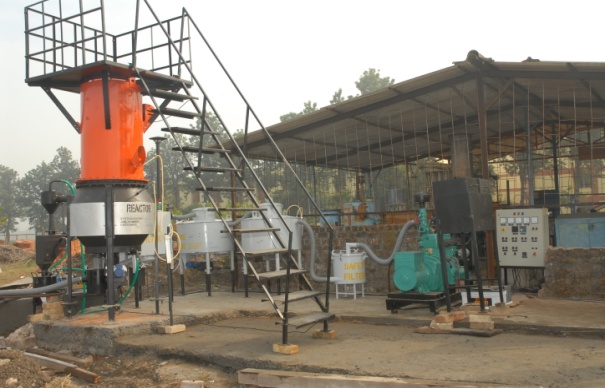
ICAR-CIAE Biomass based Power Generation System
The production capacity of the power plant is 25kW. The plant is run by biomass briquettes and other available biomass. Fuel consumption ranges between 1.1-1.2 kg/kW. The plant is equipped with a downdraft gasifier, a rotating grate, ventury type suction unit which sucks the gas as well as cleans it from tar. The system is also equipped with three stages of cleaning consisting of wood blocks, saw dust and charcoal dust for further cleaning of tars.
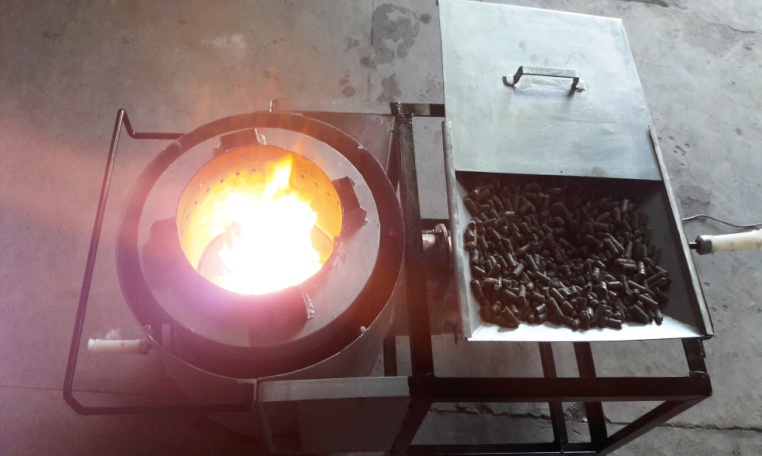
ICAR-CIAE Biomass Briquette based Rapid Combustion System for Thermal Application
A force draft rapid combustion system for thermal applications using briquettes as a fuel source comprising a combustion chamber insulated with ceramic fibre blanket, continuous biomass feeding unit with provision for feed control, raiser at the top of the combustion chamber, axial fan for air supply, cladding for thermal safety, and sliding ash bin for easy ash has been developed. The biomass feeding unit and axial fan is operated using a 12V, 7Ah battery.
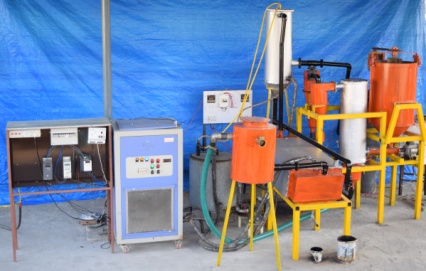
ICAR-CIAE Pyrolysis System for Bio-oil Production from Biomass
A fluidized bed reactor has been developed for 20 kg/h capacity of biomass for fast pyrolysis that comprises mainly reactor unit, cyclone, quencher, recycling unit and feeding unit. Heating coil is wrapped on the outer periphery of main reactor to raise the temperature of bed material up to 600°C and the temperature is controlled with the help of a microcontroller. A screw type feeding system has been provided to feed ground biomass inside the reactor and feed rate is controlled by varying speed by using variable frequency drives. A regenerative blower has been used to fluidize the bed of alumina and biomass inside the reactor, and nitrogen gas is used for initial fluidization of bed materials followed by subsequent fluidization using non-condensable pyrolysis vapour.
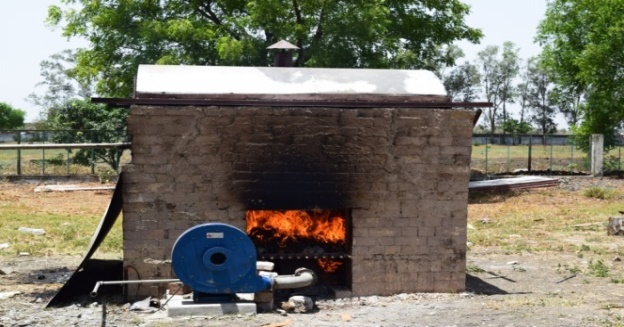
Pilot Plant for Bio-Char Production
This is a pilot plant of 300 kg loading capacity at a time. The reactor unit is indirectly heated by firing biomass. A blower is needed for burning of biomass. The outer furnace unit is made of fire bricks. Temperature can reach up to 350°C. Recovery is about 33%. Cost is 2-2.5 lakh.

Methane pyrolysis reactor for bio hydrogen production (CRP on EA)
The methane pyrolysis unit was designed with a 12 kW electric heating element, providing uniform thermal input along a heating zone measuring 1000 mm in length and 300 mm in diameter. The reactor employed a mixed catalyst bed composed of coconut husk powder and alumina balls to enhance reaction stability and heat distribution. For catalytic enhancement, nickel was impregnated onto the support at a concentration of 0.2 M, which significantly improved hydrogen production performance. Under optimized operating conditions, the system achieved a hydrogen yield of approximately 27% at 850 °C, demonstrating the effectiveness of the catalyst formulation and heating configuration..

Solar assisted micro algae harvesting system (CRP on EA)
ICAR-CIAE developed solar assisted micro algae harvesting system. This solar assisted electro-flocculation harvesting of microalgae was carried out using two solar panels of of 33V connected in series giving output voltage of 60 V to and current 6.9 A at average solar insolution on tilted surface of 5.35 kW/m 2 /day. Total time require for harvesting is 4 hours to bring down optical density of microalgae to 0.2. The harvesting efficiency of electro flocculation estimated is 81%. Fig. shows the harvesting rate of electro flocculation carried out in month December. Average power output measured is 0.315 KW and energy requirement for electro-flocculation is 2.96 kWh/kg of dry microalgae.

Insulating materials from paddy straw (CRP on EA)
Paddy straw was selected as a raw material to prepare low density composite blocks for insulating purpose at low temperature application. Shaping/ sizing was performed for mixed product through cold press (2-4Mpa, 40°C for 24h) and hot press method (4-10 MPa, 110°C for 45 minutes). The mixture was cold pressed and dried in solar dryer at 60 o C for 2 days. The dried block was laminated with FRP sheet (0.5mm). Bulk density of composite block was found as 578 kg/m 3 . A low density square block (300 ×300×25 mm) for low temperature insulation application was developed through hot pressing method. Composite consists of 83% paddy straw, 12% clay and 5% seed lac solution by volume.

Multi-utility e-vehicle for small agricultural operations
ICAR-CIAE developed a battery (60V, 100Ah) powered multi utility E-Vehicle. Effective field capacity and field efficiency for paddy crop harvesting with e reaper was found as 0.18 ha/h and 75% respectively. Operating costs for e-vehicle with reaper and planter attachment is calculated as Rs.1243/ha and Rs.874.60/ha respectively. Using MUEV the carbon emission reduction was found as 68% and 90% in harvesting and sowing operations respectively when compared with respective conventional practices.

Energy assessment of soybean crop in selected villages of MP (AICRP on EA)
ICAR-CIAE, Bhopal had a survey and collected data from the farmers of the 30 selected villages of Madhya Pradesh and a total 600 farmer's data were collected and analyzed. To evaluate efficiency, Data Envelopment Analysis (DEA), a non- parametric statistical method, was employed to identify efficient and inefficient farmers and to calculate the projected energy saving. The total energy input for soybean crop cultivation was 9,615 MJ/ha. Energy productivity (kg/MJ) for the soybean cultivation was 0.12. Specific Energy (MJ/kg) for soybean cultivation was 14.03.

CIAE-Development of bio-plastering material using paddy and soybean straw. (CRP on NF)
ICAR-CIAE developed thermally treated soybean straw based bio-plastering material. The powdered thermally treated soybean (TTS) straw is blended with a cement-sand mix at a volumetric ratio of 1:3 (cement: sand), with the sand partially or fully replaced by the treated biomass in varying proportions. The tested mix ratios include 25% replacement (1:1:2), 50% replacement (1:2:1), and 75% replacement (1:3:0) of sand with TTS straw. The properties like compressive strength, flexural strength and thermal conductivity for the developed plaster were found as 6.28MPa, 1.25MPa and 0.73W/mK respectively for the optimized combination (1:1:2)